Shreyas Shivakumara
PhD student, Immersive Visualization, Linköping University
I am a PhD student in the Immersive Visualization unit at the Department of Science and Technology, Linköping University (Campus Norrköping). I am supervised by Karljohan Lundin Palmerius and co-supervised by Gabriel Eilertsen and Patric Ljung. Before my PhD, I worked as a research engineer at Linköping University on the BIGPICTURE project and the AIDA Data Hub.
My research is in computer graphics, computer vision and VR. I work on neural scene representations such as NeRFs and 3D Gaussian Splatting, and on how to evaluate their quality. Most of my work compares image quality metrics with what people actually see, especially when the scenes are viewed in a VR headset.
Publications

abstract
Stereoscopy is fundamental to virtual reality (VR), providing depth perception through binocular viewing. Recent advances in 3D Gaussian Splatting (3DGS) enable high-quality novel view synthesis, making it well suited to immersive VR. We render 3DGS reconstructions stereoscopically and evaluate them in a head-mounted display, replicating how they would actually be viewed in VR. Real-world capture provides only a limited number of views, and under this constraint 3DGS reconstruction often produces localized floaters and misplaced structures. Standard metrics miss these localized artifacts, which become salient under stereoscopic viewing, where geometry is placed at the wrong depth.
We investigate whether standard image-quality evaluation reflects the perceptual quality of 3DGS reconstructions under reduced capture. We compare an SfM-only baseline with a union initialization that combines SfM with a dense VGGT network, holding all other training components fixed to isolate the effect of initialization coverage. A user study compares preferences under monoscopic and stereoscopic HMD viewing: monoscopically, preference for the more consistent reconstruction is weak (58.4%), while stereoscopically it rises to 78.2% and is consistent across all participants. Image-quality metrics (PSNR, SSIM, LPIPS) and stereo-aware metrics (iSQoE, StereoQA) show only modest agreement with these preferences.
abstract
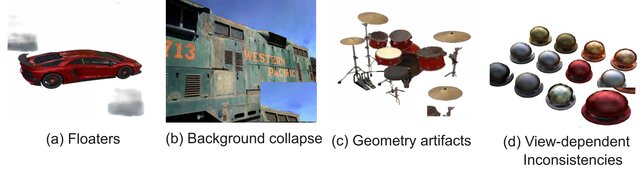
Neural Radiance Fields (NeRF) have transformed photorealistic rendering by enabling the generation of novel viewpoints from sparse sets of input images, making them valuable for gaming, filmmaking, and augmented and virtual reality applications. However, evaluating the quality of NeRF-synthesized outputs remains a significant challenge. Subjective evaluations are the gold standard but are time-consuming and difficult to scale, while objective metrics often fail to reliably capture NeRF-specific distortions.
In this survey, we review the subjective evaluation methods commonly used for NeRF and analyze their limitations, then outline existing objective metrics and their strengths and weaknesses in the NeRF context. To assess their practical utility, we conduct an empirical study of 21 objective metrics, including NeRF-specific ones, across synthetic and real-world datasets.
abstract
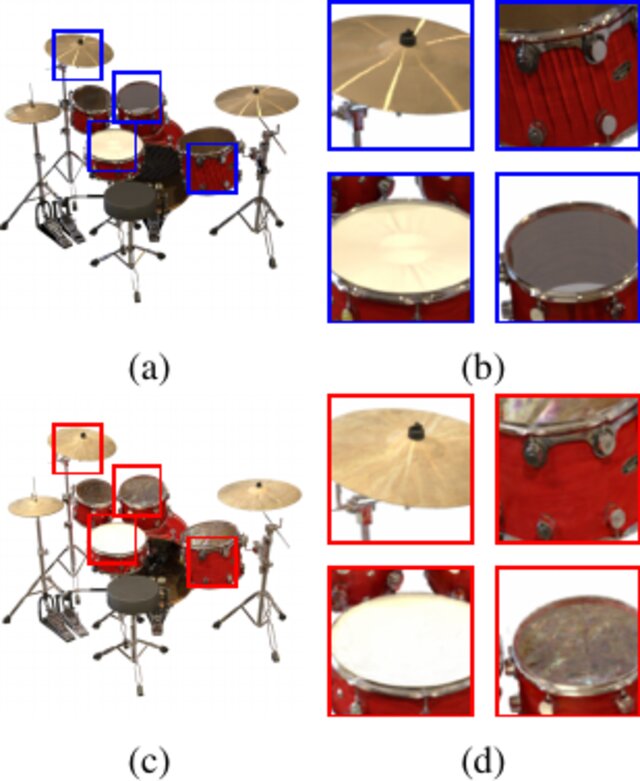
Neural Radiance Fields (NeRFs) have demonstrated significant potential in synthesizing novel viewpoints. Evaluating the NeRF-generated outputs, however, remains a challenge due to the unique artifacts they exhibit, and no individual metric performs well across all datasets. We hypothesize that combining two successful metrics, Deep Image Structure and Texture Similarity (DISTS) and Video Multi-Method Assessment Fusion (VMAF), based on different perceptual methods, can overcome the limitations of individual metrics and achieve improved correlation with subjective quality scores.
We experiment with two normalization strategies for the individual metrics and two fusion strategies to evaluate their impact on the resulting correlation with the subjective scores. The proposed pipeline is tested on two distinct datasets, Synthetic and Outdoor, and its performance is evaluated across three different configurations. We present a detailed analysis comparing the correlation coefficients of fusion methods and individual scores with subjective scores to demonstrate the robustness and generalizability of the fusion metrics.
Teaching
-
2024 – 2026
TNM046 / TNM122 - Computer Graphics
Lab assistant, OpenGL and shader labs; revised lab material in 2025 -
2025 – 2026
TNM093 - Applied Visualization and Virtual Reality
Teaching assistant -
2025
TNM119 - Introduction to Artificial Intelligence
Grading, hand-in assignments for 36 students
Supervision
- 2026 Efficient 3D Reconstruction and Real-Time Rendering of Large Environments Using Gaussian Splatting
- 2025 Adaptive Difficulty with Artificial Intelligence in Virtual Reality Games
- 2025 An Empirical Investigation of Data Calibration for Neural Radiance Fields – Analysis and Methods for Quality Improvements
Talks & Posters
- 2026Stereoscopy Reveals What 2D Metrics Miss: Robust 3D Gaussian Splatting Initialization for VR
Talk at ITN PhD Conference; posters at Nordic AI Meet (Reykjavik), ELLIIT Workshop, MIT PhD Conference - 2025Exploring Metric Fusion for Evaluation of NeRFs
Posters at QoMEX, ELLIIT Workshop, MIT PhD Conference, Nordic AI Meet - 2025Gaussian Splatting
Seminar for the Immersive Visualization and Applied Visualization units - 2024Neural Radiance Fields and their Applications
Visual Sweden project talk; unit seminar - 2024Machine Learning for Photo-realistic Exploration of Urban Environments in Virtual Reality
Poster at ELLIIT Workshop, Lund University
Background
Education
- 2023 – presentPhD student, Visualization and Media Technology
Linköping University, Sweden - 2019 – 2021MSc, Computer Science
Uppsala University, Sweden - 2015 – 2019BTech, Computer Science & Engineering
Nitte Meenakshi Institute of Technology, Bangalore, India
Experience
- 2024 – 2025Research Project (VISCP)
Linköping University, NeRF and 3DGS rendering of real environments - 2021 – 2023Research Engineer
Linköping University, BIGPICTURE, AIDA Data Hub - 2020Machine Learning Intern
SustainLab, Stockholm, Sweden - 2018 – 2019Research Assistant
Indian Institute of Science, Bangalore, India
Service
- 2025 – 2026Deputy PhD Student Representative
Linköping University, hosted the MIT PhD Conference 2025
Hobbies
When I'm not working, I'm usually out running. I do marathons and half marathons. I also play football and badminton, and from 2016 to 2019 I captained the IISc ultimate frisbee team at national tournaments.